
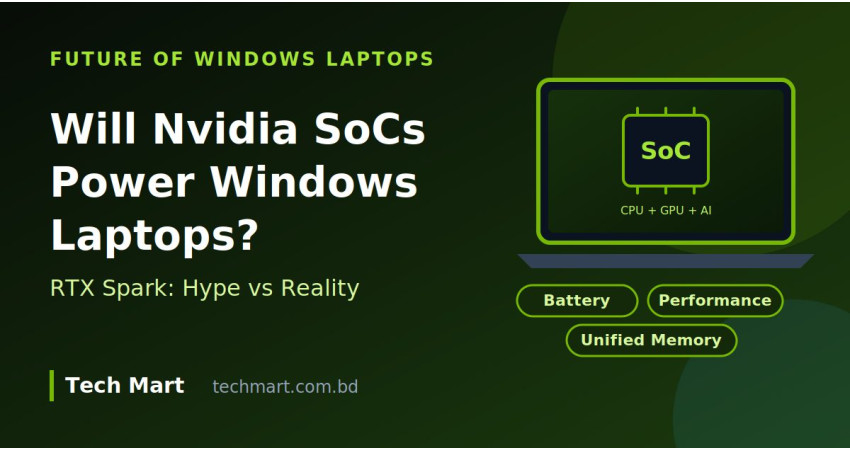
Imagine a Windows laptop that lasts all day on battery, performs like a gaming machine, and can load huge AI models into memory without a separate graphics card. That's the promise behind Nvidia's new RTX Spark chip (also referred to as the N1X), and it has some people asking: will most Windows laptops use Nvidia SoCs within the next two or three years?
It's an exciting idea, but it needs a reality check. This guide explains what Nvidia has actually announced, what the three big promises (long battery life, top performance, unified memory) really mean, and why "all Windows laptops" is a very bold prediction. Details are based on reports available in mid-October 2026, and laptops are only just starting to reach stores, so independent reviews are still limited.
Quick Answer
- Is Nvidia entering Windows laptops? Yes. Nvidia announced RTX Spark at Computex 2026, with laptops from major brands expected in fall 2026.
- Will all Windows laptops use Nvidia SoCs in 2-3 years? Almost certainly not. Intel, AMD, and Qualcomm are all still major players. A meaningful share of premium laptops, maybe, but nobody can predict it with confidence.
- Are the battery and performance claims proven? Not yet. Claims come from the companies. Independent tests are only starting to arrive.
What Is Nvidia RTX Spark (N1X)?
RTX Spark is a system-on-chip (SoC), meaning the CPU, GPU, and AI hardware sit together in one package. According to Nvidia's announcement and press reports, it includes:
- An Arm-based CPU with 20 cores, based on Nvidia's Grace design
- A Blackwell-architecture GPU, the same family used in Nvidia's current RTX graphics cards
- Up to 128 GB of unified memory shared between CPU and GPU
- Manufacturing on TSMC's 3nm process
- Design help from MediaTek, and a launch alongside Microsoft for Windows
Nvidia says first systems from ASUS, Dell, HP, Lenovo, Microsoft Surface, and MSI are coming this fall, with Acer and GIGABYTE following later. The company has talked about more than 30 laptops and around 10 compact desktops over time. Some retailers and manufacturers have listed October release dates, but exact availability and pricing vary by model and country, so check with your seller.
Promise 1: Long Battery Life
The claim: Nvidia and its partners describe slim laptops with "all-day battery life."
What we know: Arm chips are known for efficiency, which is a big reason Apple's laptops and Qualcomm's Snapdragon X laptops have earned attention for battery life. But RTX Spark is a powerful chip, with a reported typical power range of roughly 45 to 80 watts and short higher bursts. That is a lot of power for a thin laptop. Real battery life will depend on the laptop's battery size, cooling, screen, and what you're doing.
The catch: As of October 2026, independent battery tests are scarce, and the official "all-day" language doesn't come with standard test conditions. Light tasks like browsing or video playback will likely last much longer than gaming or running AI models locally. Wait for reviews before assuming the claim holds for your use.
Promise 2: Best-in-Class Performance
The claim: The GPU is reported to have 6,144 CUDA cores, the same shader count as a desktop RTX 5070, which is why the chip is being compared with high-end gaming laptops. Nvidia also highlights AI performance and says software makers such as Adobe are optimizing for the platform.
What we know: On paper, this is a strong integrated GPU by laptop standards. But "best performance" is a big claim. Final retail benchmarks, sustained speeds under heat, and gaming frame rates have not been widely published yet. Early benchmark leaks from prototypes should be treated carefully, because pre-release hardware often behaves differently from final products.
The catch: Because RTX Spark uses a shared memory pool instead of dedicated graphics memory, its memory bandwidth is reported to be lower than what a high-end discrete laptop GPU gets from dedicated memory. That could matter for some games and graphics workloads.
Promise 3: Unified Memory
Unified memory means the CPU and GPU draw from one shared pool of RAM, instead of keeping separate system memory and graphics memory.
Why it's useful:
- Local AI: large AI models can fit into the shared pool, which is hard on laptops with limited graphics memory.
- Less copying: data doesn't need to move between CPU and GPU memory, which can speed up some creative and AI workflows.
- Efficiency: a single memory system can save power and space inside a thin laptop.
The trade-offs:
- Memory is usually built into the package or soldered on in designs like this, so you likely can't upgrade it later. Choose your capacity carefully when you buy.
- High-capacity memory configurations can be expensive, especially with memory prices under pressure.
- Shared bandwidth means the GPU doesn't get a dedicated lane of fast graphics memory.
Why "All Windows Laptops" Is Unlikely
Even if RTX Spark succeeds, a complete takeover within 2-3 years is a stretch. Here's why:
- Other chipmakers aren't standing still. Intel, AMD, and Qualcomm all sell laptop chips and are updating their lineups. A separate Intel and Nvidia collaboration has also been reported, which suggests Nvidia graphics may appear in more than one kind of chip.
- Price. Premium memory and advanced manufacturing make these chips expensive. Budget and mid-range laptops make up a huge part of the market and need cheaper options.
- Software compatibility. RTX Spark is Arm-based, not x86. Windows on Arm has improved, but some apps, drivers, games, and older business software may still run slowly or not at all. This is the biggest practical risk for buyers, and it's something Qualcomm's earlier Windows on Arm laptops have faced.
- The market is huge. Thousands of Windows laptop models exist across education, business, gaming, and budget segments. Thirty-odd launch models, while significant, are a small slice.
- Supply and partners. Manufacturing capacity, memory supply, and OEM plans take years to change.
A more realistic outcome is that Nvidia SoCs become a serious option in premium thin-and-light, creator, and AI laptops, while the rest of the market stays mixed. This is my assessment, not a prediction anyone can guarantee.
What About Software Compatibility?
Before buying any Arm-based Windows laptop, check the apps you rely on:
- Does your main software have a native Arm version, or does it run through emulation?
- Do your games, anti-cheat systems, and peripherals work?
- Do specialized tools (such as CAD, accounting, or printer software) support Arm?
Windows can run many x86 apps on Arm through translation, but performance and compatibility vary by app.
Who Should Care About RTX Spark?
- AI developers and enthusiasts who want to run models locally
- Video editors and 3D creators who want portability with strong graphics
- Gamers who want a thin laptop with Nvidia features such as DLSS
- Anyone planning a premium laptop purchase in the next year or two
If you mostly browse, use office apps, and study or work online, a mainstream laptop will do the job well, and you don't need to chase the newest chip.
Should You Wait or Buy Now?
- Need a laptop now? Buy a proven model that fits your budget and software needs.
- Planning a premium laptop soon? Wait for independent reviews of battery life, heat, noise, and app compatibility.
- Check local availability. New platforms often reach some regions later, and warranty and service support vary by seller.
What to Watch in the Next Few Months
- Independent battery tests under real workloads
- Sustained performance and fan noise
- Gaming results and app compatibility on Windows on Arm
- Final pricing for different memory configurations
- Whether more brands and budget models adopt the platform
Frequently Asked Questions
Is Nvidia RTX Spark the same as N1X?
Reports indicate that N1X and RTX Spark refer to the same processor.
Does RTX Spark run on x86 like Intel and AMD?
No. It uses an Arm-based CPU, so x86 software may run through emulation unless it has a native Arm version.
Can I upgrade the memory later?
Probably not. Unified memory in this style of design is usually fixed at purchase, but confirm the details for the exact laptop model.
Will it replace Intel and AMD laptops?
It's more likely to compete with them in some segments than replace them everywhere in the next few years.
Is the battery life really all-day?
Companies say so, but independent testing is still limited. Real results will depend on the laptop and your workload.
Final Thoughts
RTX Spark is one of the most interesting shifts in Windows laptops in years, mixing Nvidia graphics, Arm efficiency, and a big pool of unified memory. But long battery life, top performance, and flexible memory are promises until real reviews confirm them. For the next couple of years, expect more choice, not a single winner. Watch the tests, check software compatibility, and choose the laptop that fits how you actually work.
Looking for your next laptop? Browse laptops, accessories, and PC components at Tech Mart.
There are no comments for this Article.