
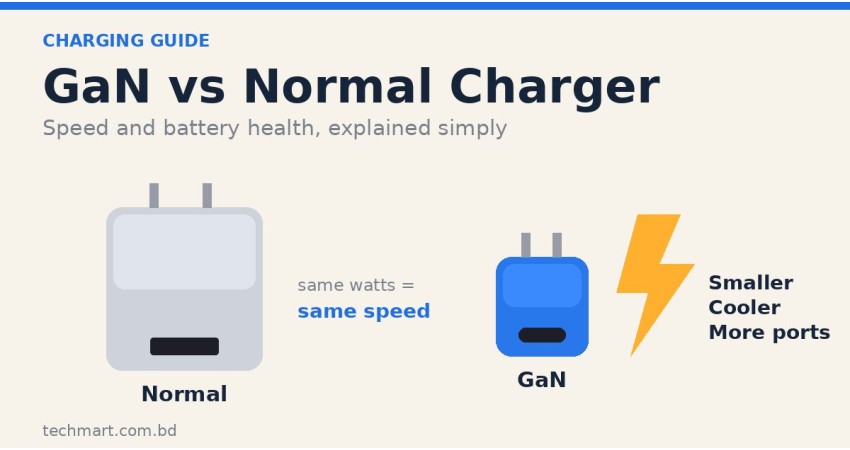
Quick answer: A GaN charger does not charge your phone faster than a normal charger with the same watts and the same fast-charging support. The real gains of GaN are a smaller size, less heat, and more power in a small body. Battery health depends mostly on heat, time at full charge, and your phone's own charging chip, not on GaN itself.
Many people think "GaN" means "faster." That is not always true. This guide explains what GaN is, what really sets your charging speed, and what matters for battery health. It was updated in November 2026.
1. Quick Facts
- GaN means: gallium nitride, a material used inside the charger
- Same watts, same protocol: same charging speed, GaN or not
- GaN's real strengths: smaller size, less wasted heat, and good for multi-port chargers
- Battery health: depends mainly on heat, time at full charge, and charge cycles
- Safe choice: a certified charger that fits your phone, whether it is GaN or not
2. What Is a "Normal" Charger?
When people say "normal charger," they often mean an old, low-power charger. It may give only 5 to 10 watts. That is slow compared with modern fast chargers.
But "normal" can also mean a regular charger built with silicon, the older material. A modern silicon charger can support fast charging too. So "normal versus GaN" is really two different questions: how many watts the charger gives, and what material it uses.
3. What Is a GaN Charger?
A GaN charger uses gallium nitride instead of silicon for key parts inside. This material wastes less energy as heat. That lets makers build a smaller charger for the same power.
GaN is most useful in high-power chargers, such as 65W or more. For small 20W phone chargers, the difference is smaller.
4. Does GaN Charge Faster?
Not by itself. At the same watts, a GaN charger and a silicon charger charge a phone at the same speed, if they support the same fast-charging protocol.
A GaN charger may look faster when it gives more watts or supports a protocol your phone can use. But that comes from its power and features, not from the GaN material.
5. What Really Sets Your Charging Speed?
Four things work together.
- Charger watts: how much power the charger can give
- Fast-charging protocol: the "language" the charger and phone speak, such as USB Power Delivery (PD), PPS, or a brand's own system
- The cable: a weak cable can limit the speed
- Your phone: it decides how much power it will take
For example, if your phone accepts only 20W, a 65W charger will not make it charge faster than 20W. The phone sets the limit.
6. What About Battery Health?
Battery wear comes mainly from heat, from sitting at full charge for a long time, and from the number of charge cycles. Your phone's own charging chip controls how much power goes into the battery. The charger does not force more power than the phone asks for.
- Heat is the main enemy: a hot battery wears out faster
- Fast charging makes heat in the phone: this is true for GaN and normal chargers
- GaN may help a little: it makes less heat inside the charger itself, but its direct effect on your battery is small
- PPS can help: on some phones, this feature can reduce heat while charging
Some sellers say that GaN protects your battery. Other guides say the material makes no direct difference to the battery. Treat strong claims with care.
7. Where GaN Really Wins: Size, Heat, and Ports
- Smaller and lighter: easy to carry in a bag, especially at 65W and above
- Cooler body: it wastes less energy as heat
- More power in one charger: good for a laptop and a phone together
- Multi-port options: one charger for several devices
If you only charge one phone at home, these gains matter less.
8. When Is GaN Worth Buying?
- You travel and want a small, light charger
- You charge a laptop and a phone together
- You want one charger for many devices
- You need 65W or more
9. When Is a Normal Charger Fine?
- You charge only one phone, at home
- Your phone needs only 20W to 30W
- You are on a tight budget
- Your current charger is safe and works well
A good silicon charger that supports your phone's fast-charging protocol can be just as fast as a GaN charger of the same watts.
10. How to Buy a Safe Charger
- Check the watts and protocol: match them to your phone (for example PD or PPS)
- Use a good cable: one made for the watts you need
- Choose a known brand: very cheap or unbranded chargers may skip safety protections
- Look for safety marks and a warranty: ask the shop
- Keep it cool: do not charge under a pillow or in direct sun
- Check your phone's own charging settings: some phones have an option to limit or slow charging
Frequently Asked Questions
Is a GaN charger faster than a normal charger?
Not at the same watts and the same protocol. Charging speed comes from watts, protocol, the cable, and your phone.
Is a GaN charger better for battery health?
Not directly. Battery wear depends mainly on heat, full-charge time, and charge cycles. GaN makes less heat inside the charger, but the effect on your battery is small.
Can a GaN charger damage my phone?
A certified charger lets the phone decide how much power it takes, so it is as safe as any certified charger. Cheap, uncertified chargers carry more risk.
Can I use a 65W charger on a phone that supports 20W?
Yes, if the charger supports the right protocol. The phone will take only what it needs.
Why is GaN smaller?
The material wastes less energy as heat, so makers can use smaller parts and a smaller body for the same power.
Final Thoughts
GaN is a good upgrade, but it is not a magic speed boost. Pick a charger by watts, protocol, and safety. Choose GaN if you want a smaller, cooler charger or more power in one place. For battery health, keep your phone cool and use a good charger.
Looking for chargers and cables? Explore more guides and product picks on our Tech Mart homepage.
There are no comments for this Article.