
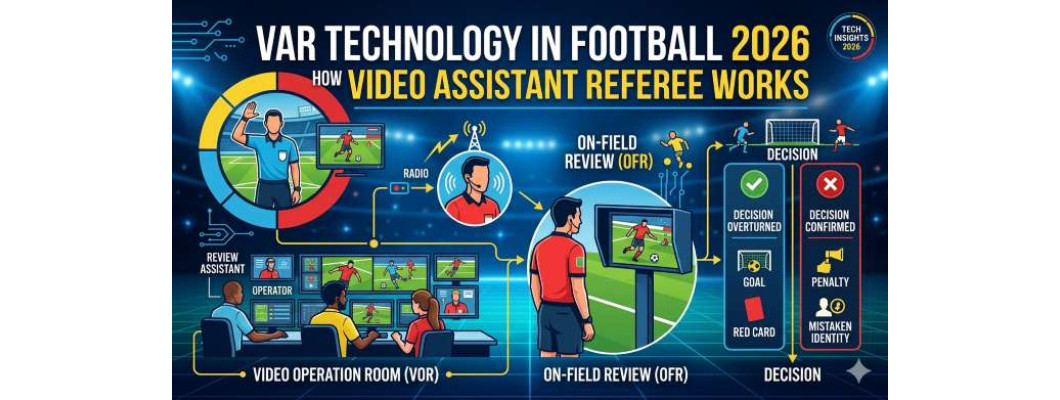
Football has changed dramatically with the introduction of Video Assistant Referee (VAR) technology, commonly known as VAR. From controversial goals to offside decisions, VAR has become one of the most talked-about technologies in modern football.
Whether you love it or hate it, VAR is now an important part of international football tournaments and major leagues around the world.
In this guide, we’ll explain what VAR is, how it works, its advantages and disadvantages, and how technology is shaping the future of football.
What is VAR in Football?
VAR stands for Video Assistant Referee. It is a technology-assisted officiating system used in football to help referees make more accurate decisions during matches.
The VAR team watches the game from a centralized video operation room using multiple camera angles and communicates with the on-field referee when a potential mistake is detected.
The system was introduced to reduce major human errors in football matches.
You can learn more about the official VAR system from the FIFA VAR guidelines.
How Does VAR Work?
During a football match, multiple high-speed cameras continuously record every moment of the game. The VAR officials monitor these camera feeds from a dedicated control room.
When a controversial incident occurs, the VAR team reviews the footage and informs the referee if a clear and obvious error may have happened.
The referee can either:
- Accept the VAR recommendation directly
- Review the incident personally using the pitch-side monitor
The Premier League VAR explanation provides additional insights into how the technology is used during live matches.
Situations Where VAR is Used
VAR is not used for every decision. According to football regulations, it is mainly used in four important situations:
1. Goal Decisions
VAR checks whether:
- The ball crossed the line legally
- There was an offside
- A foul happened before the goal
2. Penalty Decisions
VAR reviews possible fouls inside the penalty area.
3. Direct Red Cards
Serious fouls or violent conduct can be reviewed.
4. Mistaken Identity
If the referee gives a card to the wrong player, VAR can correct it.
VAR Offside Technology
One of the most advanced parts of VAR is offside detection technology.
Modern tournaments such as the 2022 FIFA World Cup used Semi-Automated Offside Technology (SAOT), which combines:
- AI-powered player tracking
- Multiple stadium cameras
- Connected match balls with sensors
- Real-time positional analysis
This technology helps officials make faster and more accurate offside decisions.
FIFA also published a detailed explanation of Semi-Automated Offside Technology.
Advantages of VAR Technology
More Accurate Decisions
VAR helps reduce clear refereeing mistakes.
Fairer Matches
Important matches become more balanced and transparent.
Better Offside Detection
Advanced tracking systems improve offside accuracy.
Improved Referee Support
Referees can review difficult situations using video evidence.
Disadvantages and Controversies
Despite its benefits, VAR remains controversial among football fans.
Match Delays
Reviews can interrupt the flow of the game.
Subjective Decisions
Some decisions still depend on human interpretation.
Fan Frustration
Celebrations are often delayed until VAR confirmation.
Inconsistent Usage
Different leagues sometimes apply VAR differently.
Famous VAR Moments in Football
VAR gained worldwide attention during the 2018 FIFA World Cup, where it was used extensively for the first time in FIFA World Cup history.
Today, VAR is commonly used in top football competitions such as:
Many famous goals, penalties, and red cards have been decided using VAR technology.
The Future of VAR and Football Technology
Football technology continues to evolve rapidly.
Future innovations may include:
- Fully AI-assisted refereeing
- Faster automated offside systems
- Smart footballs with advanced sensors
- Improved real-time decision-making tools
As technology improves, football governing bodies aim to make the game fairer while reducing unnecessary interruptions.
VAR vs Goal-Line Technology
| Feature | VAR | Goal-Line Technology |
|---|---|---|
| Purpose | Reviews match incidents | Detects whether the ball crossed the line |
| Human Review | Yes | Mostly automated |
| Used For | Goals, penalties, red cards, offsides | Goal confirmation only |
| Technology | Cameras + video review | Sensors + cameras |
You can also explore how Goal-Line Technology works in modern football.
Is VAR Good for Football?
VAR has improved decision accuracy in modern football, but debates about consistency and game flow still continue.
Some fans believe VAR makes football fairer, while others feel it removes emotional spontaneity from the sport.
However, one thing is certain: technology will continue playing a major role in the future of football.
Frequently Asked Questions (FAQ)
What does VAR stand for?
VAR stands for Video Assistant Referee.
When was VAR introduced?
VAR was officially introduced in major FIFA competitions in 2018.
Does VAR make football fairer?
VAR helps reduce major refereeing mistakes and improves decision accuracy.
What is Semi-Automated Offside Technology?
It is an AI-powered system that helps officials detect offsides more accurately and quickly.
Is VAR used in every football match?
No. VAR is mainly used in professional leagues and international tournaments.
Conclusion
Video Assistant Referee (VAR) technology has transformed modern football by combining sports with advanced video analysis and AI-assisted decision-making.
Although controversies still exist, VAR continues to evolve and improve the accuracy of football officiating worldwide.
As football technology advances further, fans can expect even smarter and faster decision systems in future tournaments.
Leave a Comment