
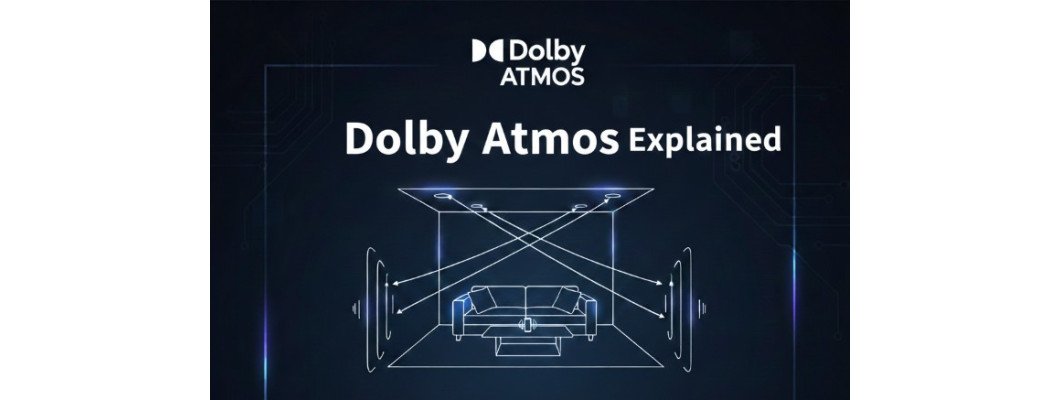
You’ve probably seen the label everywhere—on cinema hall doors, high-end soundbars, new 4K TVs, and even smartphones. But the question remains: What exactly is Dolby Atmos? Is it a genuine 3D sound experience that mimics a theater, or is it just a fancy logo used for marketing?
In today’s Tech Mart blog, we break down Dolby Atmos in the simplest way possible so you can decide if your next setup really needs it.
The Flashback: Traditional Surround Sound (5.1 vs 7.1)
To understand Atmos, we first need to understand the limitations of traditional systems like 5.1 or 7.1. These systems have been the standard for decades, but they have a specific way of working:
- 5.1 Setup: This consists of 5 speakers (Front Left, Right, Center, Surround Left, and Right) plus 1 Subwoofer for bass.
- The Limitation: These are "Channel-Based" systems. If a helicopter flies past you in a movie, the sound simply moves from the front-left channel to the rear-left channel. Every speaker on the left side plays the exact same audio simultaneously, which lacks "precise" placement.
What Makes Dolby Atmos Different?
Dolby Atmos, first introduced in 2012, broke the "channel" barrier. It isn't just another surround sound format; it is a massive leap into Object-Based Audio. Here is how it changes the game:
1. Adding the Height Dimension
Traditional sound moves around you (left, right, front, back). Dolby Atmos adds "Height". This is why you see configurations like 5.1.2 or 7.1.4. That last digit represents speakers placed above you—either on the ceiling or firing upwards to reflect sound. When it rains in a movie, Atmos makes it sound like the raindrops are actually hitting the roof above your head.
2. Audio as a "Sound Object"
Imagine a bee buzzing around your room. In older systems, that bee's sound is tied to a specific speaker. In Dolby Atmos, that bee is treated as a Sound Object. Sound designers can place that bee anywhere in a 3D space using X, Y, and Z axes. The system then intelligently decides which speakers to use to move that sound smoothly across the room—making the movement feel incredibly real.
Do You Need a Massive Speaker Setup?
You might be thinking, "I don't have speakers on my ceiling, so it won't work for me." Here is the magic: Dolby Atmos works even on smaller devices. It uses two clever technologies:
- Smart Audio Processing: The system scales the 3D audio data to fit whatever hardware you have, whether it's two speakers or twenty.
- Psychoacoustics: On soundbars or mobile phones, Atmos uses specialized algorithms to "trick" your brain into thinking sound is coming from above or behind you by manipulating sound waves.
Why It Matters for Gaming and Music
- Gaming: In competitive games, Dolby Atmos is a total game-changer. It provides "Positional Audio," allowing you to hear exactly if an enemy is on the floor above you or sneaking up from behind.
- Music: Dolby Atmos Music creates separate layers for instruments. It feels less like listening to a flat recording and more like standing in the middle of a live concert where the instruments are all around you.
Final Verdict: Is it Worth it?
Dolby Atmos is not just a marketing tag. It has fundamentally changed how sound is engineered and consumed. Whether you have a full high-end home theater or just a pair of good headphones, Atmos works to make your audio experience more realistic, immersive, and deep.
Stay tuned to Tech Mart for more simplified tech deep-dives!
Leave a Comment