
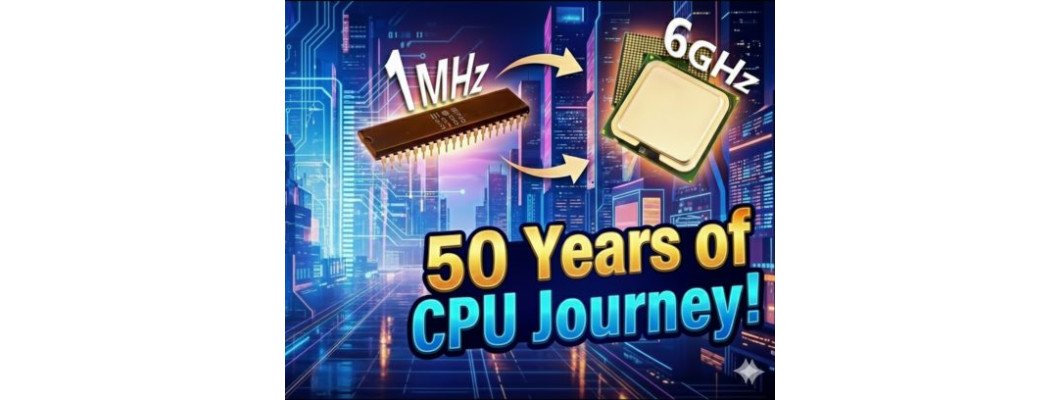
Did you know that there was a time when playing games required a CPU running at just 1 MHz?
Yes—only 1 million clock cycles per second. Fast forward to 2026, and the smartphone in your pocket performs billions of cycles every second.
Back then, even calculating 2 + 2 on a computer felt like it was taking a coffee break in between. Yet people still played games—because classics like Pac-Man, Space Invaders, and Mario defined the era. Pixels were everything.
The 8-Bit Era (1975–1985): Where It All Began
This period is known as the 8-bit era, when CPUs could process only 8 bits of data at a time. Despite the limitations, this era produced some of the most influential processors in history.
MOS 6502: One Chip That Changed Everything
- Clock speed: 1 MHz
- Transistors: 3,510
- Price: Just $25
- Designer: Chuck Peddle
While Intel’s 8080 cost $179, the MOS 6502 was affordable, efficient, and widely adopted. It powered legendary systems like Apple II, Commodore 64, and the Nintendo Entertainment System.
Remarkably, the entire Super Mario Bros game was built on this chip—and its size was only 40 KB.
Intel 8086 and the Birth of the PC vs Console War
In 1978, Intel introduced the 8086. IBM used it to create the first IBM PC. This marked the beginning of a historic rivalry: PC vs Console, and eventually, Intel vs everyone else.
Gamers soon joined the debate: “Which system is better?”
The Console Era (1985–1993): Sega vs Nintendo
During this time, you were either a Sega gamer or a Nintendo gamer—there was no middle ground.
- Sega Genesis → Motorola 68000
- Super Nintendo → Ricoh CPU
On paper, Sega was faster. But Nintendo delivered better graphics and superior game design.
DOOM (1993): The Moment PC Gaming Took Over
The release of DOOM in 1993 proved one thing clearly: PCs could do what consoles simply couldn’t.
Smooth movement, complex maps, and fast-paced action pushed PC gaming to a new level. At the time, the best CPUs for gaming were Intel 386 and 486 DX2.
The MHz War: Intel vs AMD
Then came the clock-speed race. Intel released the Pentium series, while AMD responded with K6 and later Athlon.
AMD made history by launching the first 1 GHz CPU. Intel reacted with the Pentium 4, but it suffered from excessive heat and poor efficiency.
Meanwhile, Athlon 64 became a favorite among gamers.
The Rise of Multi-Core CPUs: Core 2 Duo
By 2006, Intel realized that higher clock speeds alone were not the answer. This led to the launch of Core 2 Duo and the beginning of the multi-core era.
Later came the Core i3, i5, and i7 lineup. From 2011 to 2017, Intel dominated the CPU market.
The Ryzen Revolution: AMD Strikes Back
In 2017, AMD returned with Ryzen. Suddenly, 8 cores and 16 threads became available to mainstream users.
Ryzen 3000 (7nm) and Ryzen 5000 CPUs didn’t just compete—they beat Intel in gaming performance.
Hybrid Architecture: A New Chapter
Intel responded with hybrid architecture: Performance cores for heavy tasks and efficiency cores for lighter workloads.
Games ran at full speed, while background apps like Discord or OBS used separate cores.
Today and Beyond
Modern CPUs now feature 24+ cores, built-in AI engines, and extreme efficiency. Intel and AMD continue to challenge each other with new innovations— and consumers benefit the most.
Conclusion
From 1 MHz to 6 GHz
From 8-bit to 64-bit
From Pac-Man to Cyberpunk
This is the incredible 50-year journey of the CPU—and it’s far from over.
Stay connected with Tech Mart for more stories on technology, hardware, and innovation.
Leave a Comment