
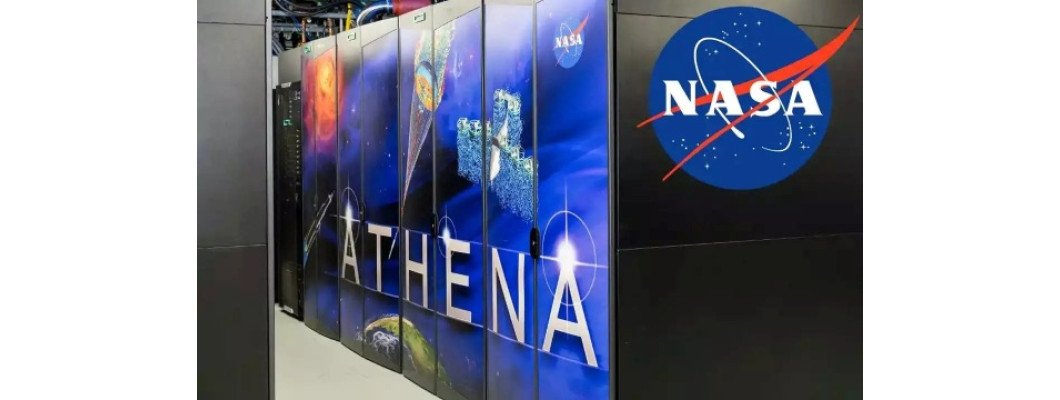
NASA’s Athena Supercomputer : Doing 500 Years of Work in Just One Day
In January 2026, NASA unveiled its most powerful supercomputer yet — Athena, a cutting-edge machine that redefines the limits of computational performance for space and scientific research. Unlike a typical powerful personal computer that most people know for fast gaming or file loading, Athena is designed to handle the massive calculations required for complex missions on Earth and beyond.
What Is NASA’s Athena Supercomputer?
Athena is housed at NASA’s Modular Supercomputing Facility at the Ames Research Center, California. It is part of NASA’s High-End Computing Capability (HECC) project, providing researchers unprecedented computing power for advanced simulations and data analysis.
The system delivers over 20 petaflops of peak performance — capable of performing more than 20 quadrillion calculations per second. In practical terms, Athena can complete in one day what a conventional computer would take approximately 500 years to compute.
What Powers Athena?
- 1,024 compute nodes powered by high-core-count AMD EPYC processors, totaling over 262,000 cores.
- Around 786 TB of system memory for processing massive datasets.
- Modular design allows hardware upgrades without major facility changes, improving energy efficiency.
Athena surpasses NASA’s older supercomputers such as Pleiades and Aitken in both performance and efficiency, making it central to NASA’s computational efforts.
What Does Athena Do?
NASA uses Athena for critical tasks requiring enormous data and complex calculations, including:
- Space Mission Simulations: Modeling rocket launches, spacecraft aerodynamics, and landing sequences for Moon and Mars missions.
- AI & Machine Learning: Training large AI models and analyzing vast scientific datasets faster than ever.
- Earth & Climate Research: Processing climate, atmospheric, and environmental data to advance scientific understanding.
- Deep Space Tracking: Predicting asteroid paths, planetary simulations, and navigation for deep space missions.
Why Athena Matters
As space exploration becomes more ambitious — from Artemis lunar missions to future Mars landings — the need for fast and precise computing is vital. Athena allows NASA to plan safer missions, reduce risk, and innovate at unprecedented speeds.
Athena is more than a machine; it is a strategic partner in space research, turning centuries-long calculations into operations completed in a single day.
Conclusion
NASA’s Athena supercomputer 2026 is a technological marvel that handles computations conventional machines cannot. It enables faster research in space exploration, AI, climate modeling, and more, marking a major leap in high-performance computing for the 21st century.
Stay tuned to Tech Mart for the latest updates on NASA’s cutting-edge technologies and supercomputing breakthroughs.
Leave a Comment