
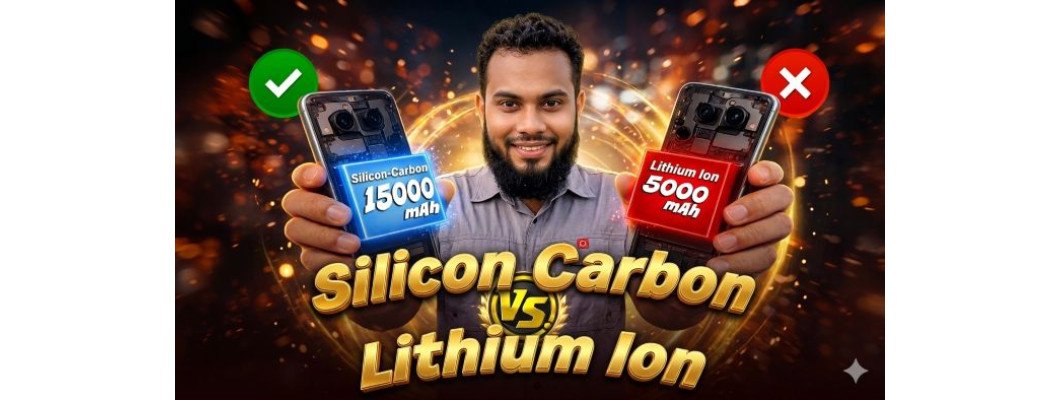
Imagine a smartphone with a 10,000mAh to 20,000mAh battery without increasing thickness.
Just a few years ago, this sounded impossible. But in 2026, it is becoming reality — thanks to Silicon Carbon battery technology.
Earlier, smartphones were limited to:
- 3000mAh → Standard
- 4000mAh → Improvement
- 5000–6000mAh → Modern standard
Now, manufacturers are pushing boundaries beyond imagination.
What is Lithium-ion Battery?
Most smartphones today still use Lithium-ion (Li-ion) batteries.
How it works
A lithium-ion battery has two main parts:
- Cathode: Lithium-based material
- Anode: Usually graphite
During charging, lithium ions move from cathode to anode. During usage, they move back — creating electricity.
Limitation
The biggest limitation is energy density — how much power can be stored in a small space.
What is Silicon Carbon Battery?
Silicon Carbon (Si-C) battery replaces graphite in the anode with silicon-based material.
This is a major breakthrough because silicon can store significantly more lithium ions.
Think of it like this:
A bookshelf that originally holds 100 books is redesigned to hold 300 books without increasing size.
That’s exactly what Silicon Carbon does to batteries.
Key Differences: Silicon Carbon vs Lithium-ion
| Feature | Lithium-ion | Silicon Carbon |
|---|---|---|
| Energy Density | Standard | 10–25% Higher |
| Charging Speed | Moderate | Ultra Fast (80W+ support) |
| Lifespan | 3–5 Years | 7–10 Years |
| Heat Management | Better Stability | Requires Cooling Systems |
| Cost | Affordable | Premium |
Why Silicon Carbon is a Game Changer
- Higher battery capacity without increasing phone size
- Faster charging with lower resistance
- Better performance in premium smartphones
- Future-ready for 15,000–20,000mAh devices
Brands like Xiaomi, realme, and others are already experimenting with next-gen high-capacity batteries.
Challenges of Silicon Carbon Technology
- Battery swelling issue (partially solved using carbon matrix)
- Higher production cost
- Heat management complexity
- Long-term durability still under research
Future of Battery Technology
In the near future, we may see:
- Smartphones with 15,000–20,000mAh batteries
- Smartwatches lasting 10–15 days on a single charge
- Less dependency on power banks
This will completely change how we use mobile devices.
Tech Mart Product Integration
To fully experience next-gen battery performance, you need proper charging accessories.
Recommended Tech Mart Products:
- Fast Charging GaN Chargers (65W–120W)
- High-Capacity Power Banks (20,000mAh+)
- Premium USB-C Cables for stable power delivery
Why Tech Mart?
Tech Mart ensures reliable, high-performance accessories for modern devices — helping you get maximum efficiency from new battery technologies.
Final Thoughts
Silicon Carbon is not just an upgrade — it is the beginning of a new battery era.
While Lithium-ion remains reliable, Silicon Carbon is clearly the future of mobile power.
What do you think? Will Silicon Carbon completely replace Lithium-ion in the next few years?
Stay updated with Tech Mart Bangladesh for more tech insights.
Leave a Comment