
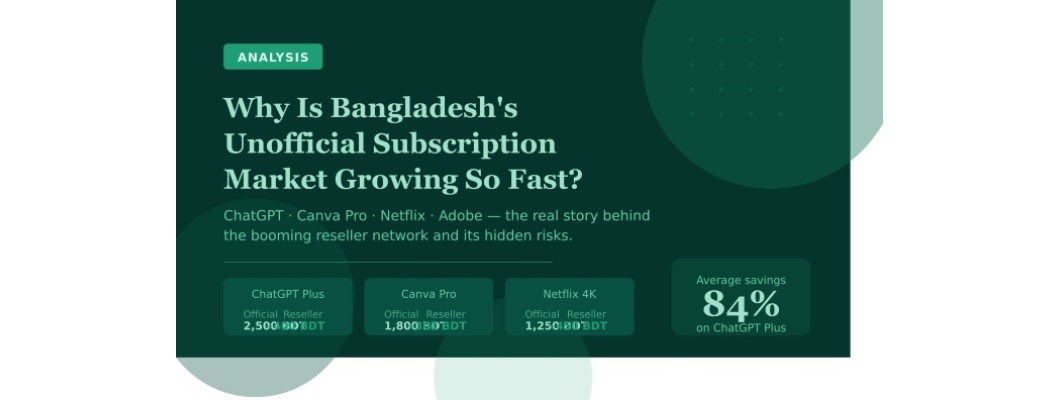
Why Is Bangladesh's Unofficial Subscription Market Growing So Fast?
Over the past few years, the demand for digital tools in Bangladesh has skyrocketed. ChatGPT, Canva, Netflix, Adobe — these names are now on the lips of freelancers, students, and small business owners alike. But the official prices of these services, combined with the complexity of international payments, remain a major barrier for many. And it is precisely in this gap that a massive unofficial reseller network has taken root.
Resellers buy subscriptions in bulk, use family or team plans, or source packages from lower-priced regions — then resell them in local currency through bKash and Nagad to everyday users.
How Big Is the Price Gap?
The difference between official prices and reseller prices is striking:
- ChatGPT Plus: Official ~2,500 BDT/month — Reseller ~400 BDT
- Canva Pro: Official ~1,800 BDT/month — Reseller ~300 BDT
- Netflix 4K: Official ~1,250 BDT/month — Reseller ~450 BDT
- YouTube Premium: Official 239 BDT/month — Reseller ~125 BDT
Why Is This Market Growing So Quickly?
According to the ICT Division, Bangladesh has approximately 650,000 freelancers. Research shows that a large portion of them earn less than $209 per month — making it nearly impossible to pay full international prices for multiple tools at once.
"For most freelancers, paying the full international price for several tools at once becomes almost impossible."
— Freelancer Sourav Biswas
Three key factors are fueling this market:
- International payment barriers: A large number of users do not have international credit cards, and paying in US dollars is complicated and cumbersome.
- Essential for professional work: For designers, content creators, and students alike, AI tools are no longer a luxury — they are a necessity.
- Shared account model: Resellers purchase family or team plans and split access among multiple users, selling each slot at a fraction of the original cost.
A Reflection of Digital Inequality
Professor B M Mainul Hossain, Director of the Institute of Information Technology at the University of Dhaka, says the growth of the reseller market reflects a deeper digital divide.
"Global pricing is often far too high for countries like Bangladesh. Without regional pricing or localized access models, a large portion of users simply cannot afford these services."
— Professor B M Mainul Hossain, University of Dhaka
What Are the Risks?
The low price comes with hidden costs that many users overlook.
- Privacy risk: On shared accounts, your prompts, browsing history, and personal data may be exposed to other users or the reseller.
- Malware and credential theft: Some resellers use browser extensions or request remote access — creating serious risks of identity theft and account hijacking.
- Account suspension: Platforms like Netflix, Adobe, and ChatGPT may permanently ban accounts found violating sharing policies, resulting in loss of data and access.
"What appears financially attractive in the unofficial subscription market often comes with hidden compromises on cybersecurity and personal privacy."
— Arif Moinuddin, Cybersecurity Expert
What Is the Solution?
Experts suggest the problem can be addressed in two key ways:
- Regional pricing: If global tech companies adopted pricing based on local purchasing power, users would have a genuine incentive to subscribe through official channels.
- Local payment integration: Supporting payment methods like bKash, Nagad, and Rocket would remove the biggest barrier for millions of potential subscribers.
Conclusion
Bangladesh's unofficial subscription market is not simply a story of people looking for cheap deals — it is a symptom of a real digital and economic divide. Demand for technology is growing, but access remains deeply unequal. Without meaningful policy changes and action from global tech companies, this parallel market will only continue to grow.
Leave a Comment